Showing posts with label coffee. Show all posts

Friday, October 24, 2025

The Origins and Evolution of the Americano Coffee

The word Americano means “American” in Italian, Spanish, and Portuguese, and some linguists believe it entered English from Italian in the 1970s. In the context of coffee, Caffè Americano translates directly to “American coffee.” Despite its name, this popular beverage did not originate in the United States but rather in Italy during World War II—a testament to how cultures adapt and influence one another.

The story of the Americano begins when American soldiers were stationed in Italy and first encountered the country’s beloved espresso. Italian espresso was far stronger and more concentrated than the drip coffee to which the soldiers were accustomed back home. Seeking a more familiar flavor, they began diluting espresso shots with hot water to approximate the taste and volume of American-style coffee. This simple adjustment resulted in a smoother, milder drink that still retained the rich aroma of espresso. Over time, this wartime improvisation became known as Caffè Americano—literally, “American-style coffee.”

After the war, the Americano spread throughout Europe and eventually gained popularity in the United States. Coffee enthusiasts appreciated its balance: the depth of espresso without the overpowering bitterness. The drink soon became a fixture in cafés worldwide, appealing to those who preferred a lighter alternative to straight espresso while maintaining a robust coffee flavor.

Traditionally, a caffè Americano is made by combining one or two shots of espresso with approximately 120 to 180 millilitres of hot water. This ratio can be adjusted depending on personal preference. The result is a beverage that bridges two coffee traditions—the intensity of Italian espresso and the comforting familiarity of American brewed coffee.

Today, the Americano remains one of the most popular espresso-based drinks globally. Whether enjoyed in a small Italian café or a modern coffee chain, it continues to symbolize the blending of cultures and tastes, offering coffee drinkers a smooth yet flavorful experience that connects history, adaptation, and timeless enjoyment.
The Origins and Evolution of the Americano Coffee

Saturday, June 13, 2020

Invention of coffee roaster by Jabez Burns

By the final third of the 19th century, coffee was already a 1,000-year-old drink. And throughout all that time, coffee beans needed to be roasted before they could be used to brew coffee. Initially this was done in open pans and then, from the beginning of the 18th century and for many decades after, in hand operated cylindrical roasters over an open flame or a brazier.


The first successful commercial coffee roaster was invented in 1864 by Jabez Burns, who came to New York from London in 1845 and found employment with coffee and spice merchants.

Mr. Burns was born in London in 1826. Experimenting with more reliable method for roasting coffee beans, he realized that the key was not to allow the beans to rest directly on a hot surface, where the quickly scorch. Burns devised a screw-like device to keep the beans moving as they roasted. He took out his first patent for an industrial roaster in 1864.

He founded the business of Jabez Burns & Sons in 1864, beginning the manufacture of his patent coffee roaster at 107 Warren Street New York.

In 1934 the Jabez Burns company developed a machine that applied no heat whatsoever to the drum itself. The burns machine dispensed with the heat outside the drum, instead relying on a high-velocity blast of hot air roaring through the drum, thus roasting the coffee more by contact with hot air than by contact with hot metal.
Invention of coffee roaster by Jabez Burns

Tuesday, October 17, 2017

Max Morgenthaler invented Nescafé

Like many brand innovators, Nescafé was a result of intensive research - seven years of research to be precise taking place in Swiss Laboratories. In 1930 the Brazilian Coffee Institute contacted Nestlé to develop granulated coffee, soluble in hot water and that retained its flavor.

The background to this inquiry was that Nestlé through it dry milk products has a worldwide reputation and that Brazil produced coffee in abundance, such that the country was forced to destroy part of its crops so as not to see prices fall through the floor on the world market. Through a collaborative approach with the Brazilian Government, and seven years of research, a group of Nestlé scientists, led by chemist Dr Max Morgenthaler, developed Nescafé.

Many more or less successful trials were performed by Max Morgenthaler showed a recurring problem of a very hygroscopic extracted soluble coffee power.

In the spring of 1931 a soluble powder was finally produced that could be manufactured on an industrial scale. The breakthrough product was announced and introduced on 1 April 1938 at Nestlé’s headquarters in Vevey.

Over the years Nescafé has kept the emphasis on innovation, introducing pure soluble coffee (1952) solely using roast coffee beans, freeze-dried soluble coffee (with the launch of Gold Blend in 1965) and coffee granules (1967). In 1994 it invented the ‘full aroma’ process, which improved the quality of instant coffee.
Max Morgenthaler invented Nescafé

Wednesday, June 21, 2017

Automatic espresso machine

Against a backdrop of economic depression and varied competition that included negative advertising, it took technology to advance the coffee business.
Many households switched from making coffee with a percolator, first invented in 1829 with an electric version available in the 1930s, to either a drip method or a vacuum coffee maker. Experimentation with creating an espresso machine began in the nineteenth century. The first commercial espresso machine was manufactured in Italy in 1905.

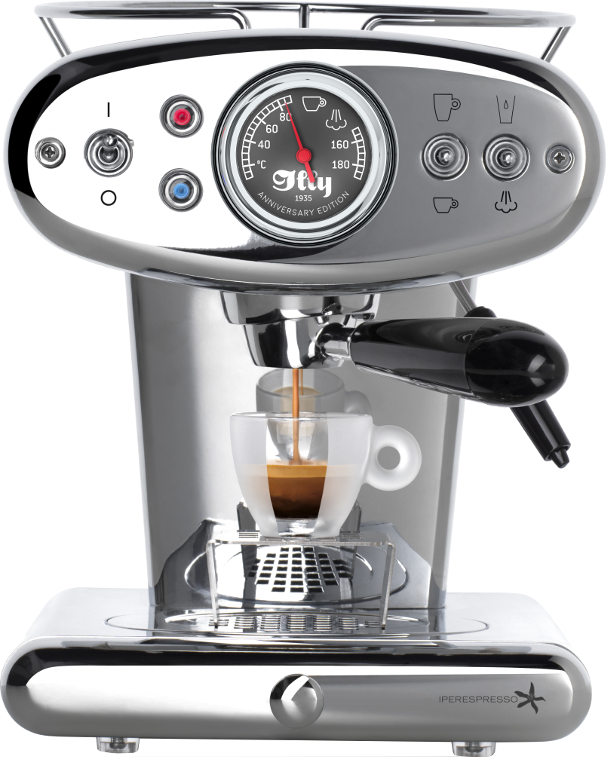
In 1933, Ernest Illy invented the first automatic espresso coffee machine. The espresso machine is perfected in 1945 with a piston that creates a high pressure extraction which produces a thick layer of crema .

Drawing its inspiration from an Italian invention, the Espresso machine, Nestlé launched Nespresso in 1986.
Automatic espresso machine

Tuesday, April 4, 2017

Invention of coffee maker by Melitta Bentz

A coffee maker called a percolator was invented in France in 1827. The percolator was designed to heat water and brew coffee in one operation, by pumping hot water through coffee grounds.

Filtered coffee also known as drip coffee is the newest method of coffee infusion and the preferred method of coffee aficionados. Filtered coffee was invented by a Dresden (Germany) housewife in 1908 named Melitta Bentz. At the time, people put ground coffee seeds into cloth bags and brewed them in hot water.

Bentz hankered after a tastier and more efficient way to brew her home-made coffee and had tired of the old choice between a Turkish coffee with grounds in the bottom of the cup, or with the grounds messily strained out through a dishcloth. Often, the grounds seeped into the coffee when the bags became worn, making the beverage undesirable to drink.
Bentz placed a sheet of blotting paper inside a brass pot that had holes in the bottom and poured hot water through the top. She discovered that the ground remained inside the paper, and did not seep into the beverage.

She patented it as the ‘Filter Top Device Lined with Filter Paper’. Bentz went into business with less than 1 Deutschmark and established a company Melitta to sell her wonderful new product.

The first year, Bentz sold 1250 coffee filters at a fair. By 1912, she had established a business a to manufacture coffee filters.

In the 1960s, the company began marketing a coffee maker in the United States with a wedge-shaped filter holder and filters that open like a pocket, so the water passes through only one layer of paper.
Invention of coffee maker by Melitta Bentz

Tuesday, April 7, 2015

Invention of espresso machine

The first prototype of an espresso machine (made in Italy) was unveiled in the early 1800’s. It was an Italian named Luigi Bezzera who invented the espresso machine. He built a machine that could force water through a series of filters at high pressure. It turned out that not only did it make coffee faster, it also made coffee better.

He filed for a patent in 1901. In 1903, Desidrio Pavoni purchased the patent from Luigi Bezerra and the Pavoni Company started developing coffee machines in 1905 which were based on Luigi’s patent.

The machines produced by the company came to be known as the ‘La Savona’ and became famous immensely.

In 1915, Corning Glass Work’s introduced a coffee maker made from Pyrex. This ovenproof glass was marketed under the name ‘Silex’.

The first espresso machine installed in an American restaurant was at Regio’s, in New York City in 1927. 

The automatic espresso maker began its journey in the 1930’s. One of the first electric coffee machines was made by Willy Brandl.

The most innovative invention of the electric coffee maker was the switch that turned it off after the right time.

In 1933, Dr Ernest Illy invented the first automatic espresso coffee machine. Drawing its inspiration from an Italian invention, the Espresso machine, Nestlé launched Nespresso in 1986.
Invention of espresso machine

Popular Posts

Other Interesting Articles